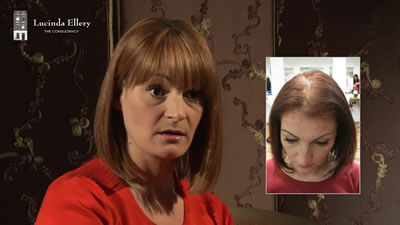



Female Pattern Hair Loss
Female pattern hair loss (FPHL) is also widely known as Androgenetic Alopecia and is the most common form of women’s hair loss globally. It can start as early as puberty, but occurs most commonly after the menopause.
Jacqui showing the effects of FPHL

Jacqui after the application of the Intralace System
Severe FPHL and the Intralace System
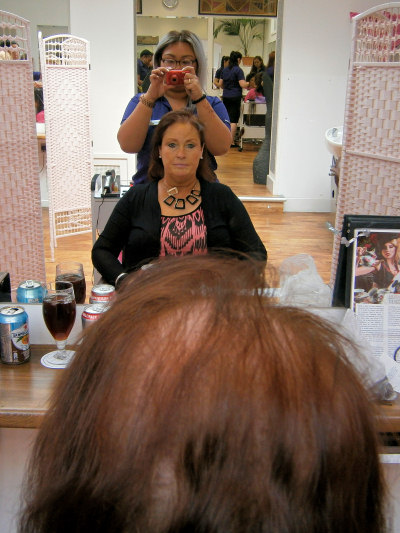
Many ladies with chronic Female Pattern Hair Loss have avoided the stress of thinning hair by using one of our Intralace Options. Hair loss from severe FPHL is often not drastic enough to require a wig, although it is still upsetting and can wield an intense psychological impact.
At your consultation we will confirm if the Intralace Minima or the Intralace System would be the most suitable option for you.
They are both extremely effective ways of disguising the hair thinning or hair loss and need to be maintained by us approx once every 6 weeks to manage your natural hair growth.
Jacqui Pulling began using our Intralace System in July 2014. Prior to this Jacqui managed to conceal her hair thinning for a number of years by using scalp make-up however like many others she became frustrated with having to apply the product daily and her hair thinning became very difficult to conceal so she wanted a more permanent option. The Intralace System gives her the freedom of having a full head of hair which is used 24/7 and is treated just like her own hair.
See examples of how the Intralace Minima and the Intralace System can help manage FPHL
Mild FPHL
Female pattern hair loss is a genetically linked condition and can be inherited from both sides of the family. Mild FPHL can usually be managed fairly simply with scalp make-up and hair styling, or by using our Medi Connections™ (ultra-fine and very safe hair extensions), which typically last around three months.
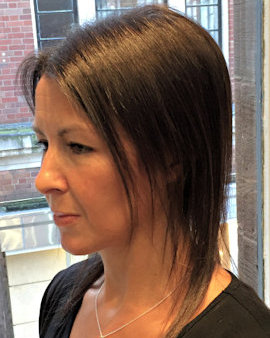

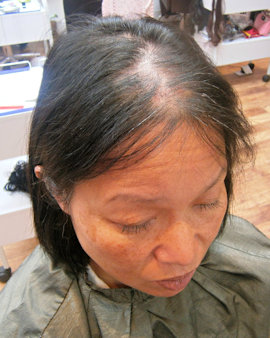

Dr Vicky Joliffe is a London based Dermatologist with a special interest in hair disorders. She says:
‘By pattern hair loss we mean a reduction in hair thickness which occurs in a certain ‘pattern’ - usually affecting the crown of the head, sometimes revealing visible scalp, whilst the density of hair at the back of the head usually remains normal. This type of loss is sometimes genetic and may also occur with a number of medical conditions e.g. polycystic ovary syndrome or conditions in which testosterone levels or hair follicle sensitivity to circulating testosterone is increased.
Sometimes tablet treatment aimed at reducing the effect of testosterone on the hair follicle may be prescribed for this type of hair loss. Such treatments may include the oral contraceptive pill or antiandrogen tablets. Treatments aimed at prolonging the growth phase of the hair and thereby thickening and lengthening the hair fibers may also be used such as Minixidil. Some doctors advocate the use of scalp rollers or Laser Hair combs to help thicken hair in this condition.’
Our Locations
Our UK studios are conveniently situated in central locations in:
London
Location Map - Directions (tube)
Manchester
Location Map - Directions (train / car)
Edinburgh
Location Map - Directions (train)
Bristol
Location Map - Directions (train)
Midlands (Solihull)
Location Map - Directions (train / car)
Southampton
The Next Step
To arrange a private consultation at The Lucinda Ellery Consultancy please call:
0208 741 8224 - London Call
or use the London contact form
0161 359 3345 - Manchester Call
or use the Manchester contact form
0131 526 3222 - Edinburgh Call
or use the Edinburgh contact form
(0117) 203 3222 - Bristol Call
or use the Bristol contact form
0121 289 3567 - Midlands (Solihull) Call
or use the Solihull contact form
023 8110 3275 - Southampton Call
or use the Southampton contact form