



Alopecia Areata (AA)
Alopecia Areata most commonly affects younger women and children. The condition is due to an auto-immune response, where the blood in the body forms white cells that attack the hair follicles which produce hair. It causes hair growth to stop, and the follicle enters a resting phase of its cycle which leads to hair loss.
Most cases of AA are characterised by a shiny patch of scalp that becomes visible through the hair and feels silky smooth. Hair loss from AA can be sudden, developing in just a few days which can be very difficult to adapt to emotionally.
Alopecia Areata and the Intralace System™
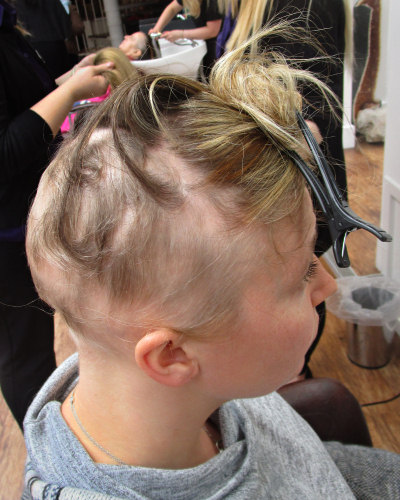
Francesca showing the effects of Alopecia
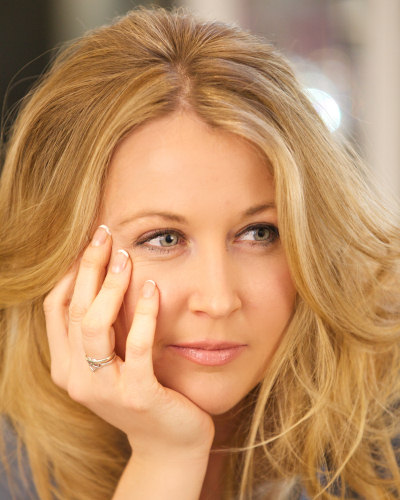
Francesca after the application of the Intralace System
Clients who have patches of hair loss from Alopecia Areata are suitable for our Intralace System. Our client Francesca first came to see us with AA in July 2011 and used the Intralace System to conceal her patches of hair loss. Francesca’s hair completely grew back underneath the Intralace System so she had her System removed at the beginning of 2012. She then contacted us in 2015 as she had started to lose her hair again and is currently using the Intralace System to help manage her hair loss.
Francesca made a great video on the day of getting her new Intralace, watch it on Youtube
AA can improve over time
Alopecia Areata is a very unpredictable type of hair loss. For some clients one or two patches may develop and then the hair fully grows back. In other cases clients can experience rapid hair loss which can sometimes result in total hair loss. The hair will sometimes grow back but it may then fall out again. Many people will need to manage Alopecia Areata for a number of years.
Our client Imogen experienced total hair loss from Alopecia Areata and she chose to use the Intralace System to conceal her hair loss. Imogen's own natural hair has now successfully regrown underneath the Intralace System.
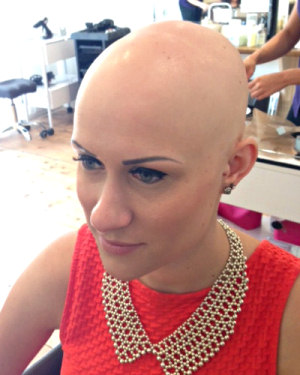
Imogen with total hair loss
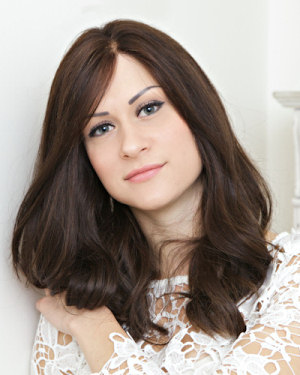
Imogen with Intralace
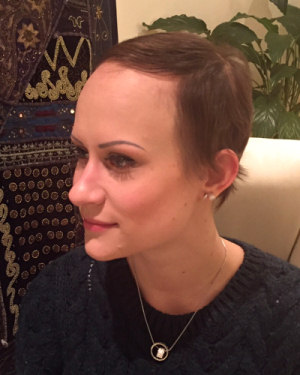
Imogen with regrowth
A Dermatologist’s diagnosis of AA and Treatments for AA
Dr Vicky Joliffe is a London based Dermatologist with a special interest in hair disorders. She says:
‘This is an autoimmune condition in which the immune cells in the body attack the growing hair, causing it to fall out. It may affect any hair at any site and sometimes runs in families. We do not know fully what triggers this condition which can be very distressing and for which there is currently no cure.
Treatments which may be offered include injections of steroid into the scalp, application of topical preparations which aim to promote hair growth by causing irritant reactions on the skin and occasionally immunosuppressive tablets which have a number of significant side effects. There is a lot of ongoing research into Alopecia Areata and we all eagerly await more news regarding this distressing condition’
Our Locations
Our UK studios are conveniently situated in central locations in:
London
Location Map - Directions (tube)
Manchester
Location Map - Directions (train / car)
Edinburgh
Location Map - Directions (train)
Bristol
Location Map - Directions (train)
Midlands (Solihull)
Location Map - Directions (train / car)
Southampton
The Next Step
To arrange a private consultation at The Lucinda Ellery Consultancy please call:
0208 741 8224 - London Call
or use the London contact form
0161 359 3345 - Manchester Call
or use the Manchester contact form
0131 526 3222 - Edinburgh Call
or use the Edinburgh contact form
(0117) 203 3222 - Bristol Call
or use the Bristol contact form
0121 289 3567 - Midlands (Solihull) Call
or use the Solihull contact form
023 8110 3275 - Southampton Call
or use the Southampton contact form
Follow Us

